Last Updated Jun 04, 2026
A letter from Anuj: what Mirae is all about
Mirae is a story many years in the making. It’s a personal mission and a labor of love for all of us on the team. I hope in time we share everyone’s “why Mirae” stories here.
My story starts many years ago, at 116 Hurley Avenue in Kingston New York. A fairly nondescript yellow house occupies this address. In 1986 my dad started his medical practice as a colorectal surgeon, converting this house into a medical practice. My parents immigrated from India thanks to my dad’s acceptance into residency and eventually fellowship in the US. Upon completing his training, my parents settled in this small upstate NY town where my sister and I grew up. As a small boy, this converted house, now medical office, was both my daycare center and my playground. I helped my dad landscape the plants and lawn around the house. The lower level garage became a workshop of sorts, where my dad and I built much of the furniture my sister and I used, along with toy cars, a swing set in our backyard and many other things. My dad had all this free time because initially, his practice struggled to obtain referrals. (At that time, being a solo practitioner sub-specialist surgeon was normal; today, it would be impossible.) It’s been a 40 year journey for my dad, tens of thousands of patients treated, countless surgeries, late night calls, and a reputation that has patients in a 50 mile radius begging him not to retire. His practice was a true labor of love and a family business, my mom managed the billing and revenue cycle management (all on a simple series of Excel worksheets, no AI workflows thank you very much).
There are two things from that upbringing I carry into Mirae:
The first is that healthcare is inherently a trust business, as my dad used to say. You have to earn the trust of a patient and you have to display your competency; your right to treat has to be earned. No amount of technology changes that. If patients don’t trust what we build, it won’t matter how good the model is.
The second is that good care isn’t evenly distributed. As my dad winds down his practice, the people who counted on having a real specialist in a small upstate town won’t have one. They’ll drive an hour or two, or they’ll put off the appointment until something goes wrong. That story repeats in thousands of towns across America. I’ve spent my career at the intersection of technology and healthcare, most of it circling that problem, trying to make the kind of unhurried specialty care that used to happen at 116 Hurley Avenue available to people who live nowhere near it.
We started with IBD because IBD patients sit at a brutal intersection of a condition that is chronic, complex, and acute all at once. They need specialty care more than almost anyone, and they hit more obstacles getting it. Diagnosis alone often takes the better part of a year, and for some people far longer. One large UK study found patients reporting gut symptoms up to a decade before the disease was named. Critical decisions such as what biologic therapy to start are made with incomplete information. As a result, roughly half of patients are moved off of their first biologic within twelve months. That number isn’t an indictment of the drugs. It’s a sign of how little information anyone has when choosing between them.
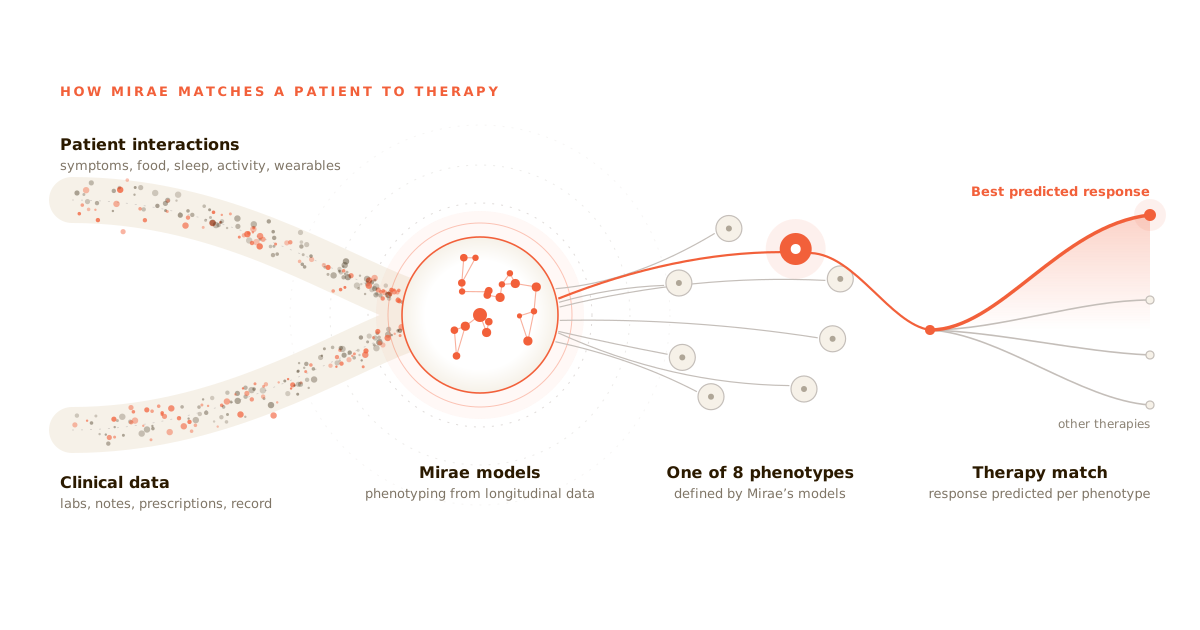
Both of these problems are solvable today with technology. AI should make high quality precision specialty care infinite. The promise of precision medicine requires knowing far more about a patient than a fifteen-minute visit every six to nine months can capture. Critical things, like how symptoms actually move week to week, what someone is eating, how much they’re moving, mapped against the labs that measure what’s happening inside them. Almost nobody collects that. Without it, even the best gastroenterologist in the country is making an educated guess about which medication will work for the person in front of them.
So that’s what we’re building first: a guide patients actually want to use, and the decision support that lets any GI practice care for IBD the way the best academic centers of excellence do.
Mirae’s longer term master plan is built around the belief that the best drug discovery company of tomorrow has to be a care delivery company today. We will write more about what that means for precision medicine and drug discovery in the months ahead. But none of it is possible until we’ve earned the right to be in a patient’s pocket. That’s the work in front of us.
Our journey will be long and complicated, but we have the support of wonderful academic partners at Oxford University, numerous strategic and institutional investors, and most importantly a world class team I’m privileged to work with.
It’s been 40 years since 116 Hurley Avenue opened its doors to the community. As those doors close, we are proud to (officially) open ours to the IBD community.
Read More Posts

Let Mirae guide the way forward
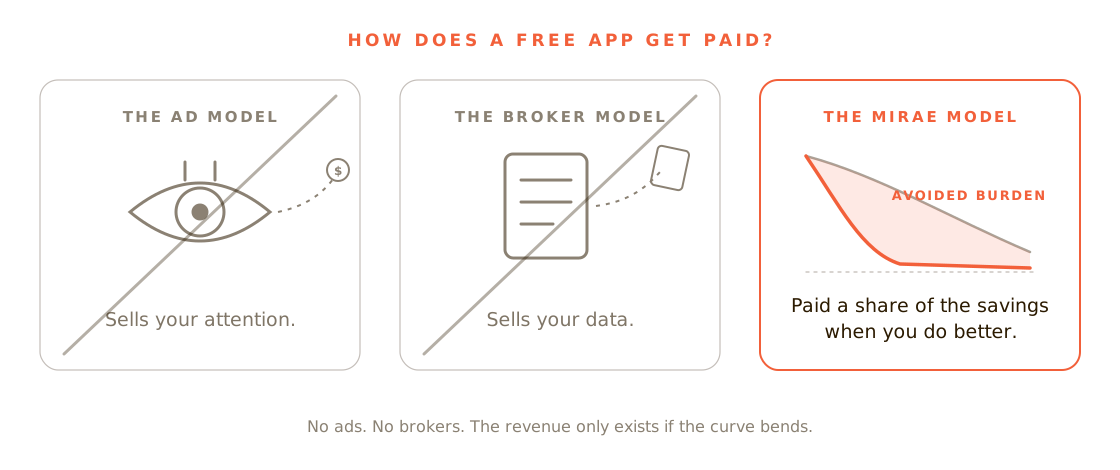
Bring your symptoms, food, medications, lab results, and questions together so you can understand what is changing and prepare for your next care conversation. Mirae is free. There is no paid plan, no trial period, and no card needed to start using the app.