Last Updated Sep 09, 2026
Inverting the precision medicine funnel
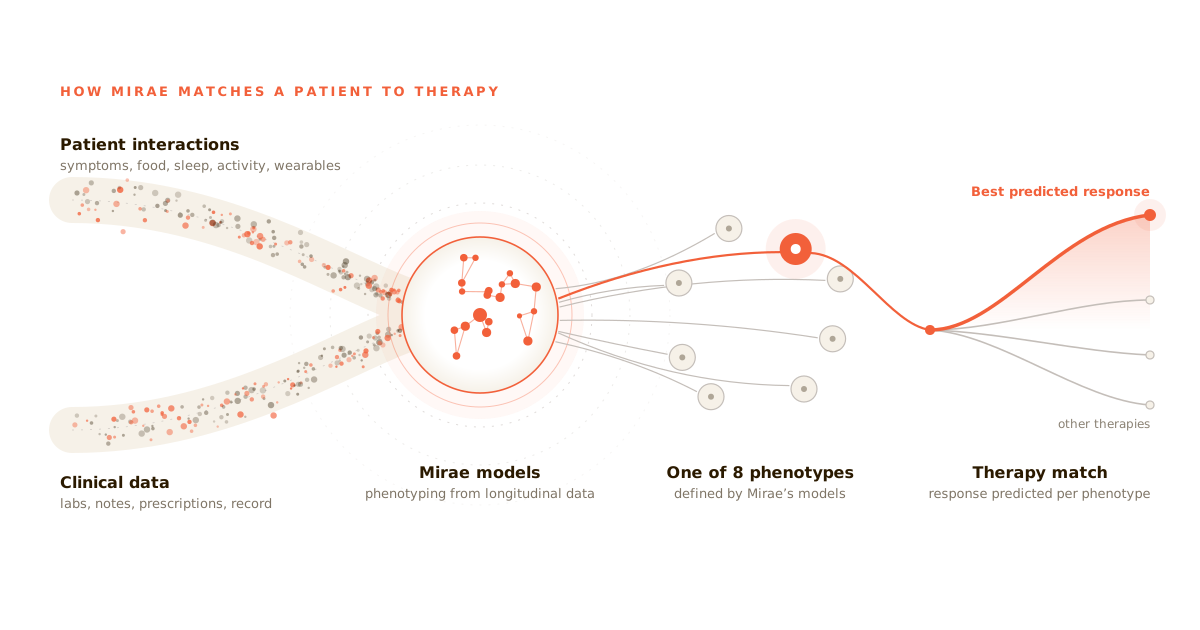
Precision medicine in IBD has been built from the molecule up: profile a small cohort deeply, identify a novel signature, many years later translate that to bedside. Mirae is building precision medicine in the opposite direction. Start from a continuous relationship with the patient, let AI define phenotypes from longitudinal data across a living population and deliver care against them today against the commercial availability of biologic therapeutics. What is most important for Mirae at the end of the day is if we accomplish our ultimate goal of remission or a cure for a patient: the fastest and most effective way of letting patients resume their original, healthy day-to-day lives.
Medicine and clinical care have a way of humbling you. We’ve been working on the idea of Mirae for more than a year and during that time have had hundreds of conversations with GI clinicians and patients with inflammatory bowel disease. Despite petabytes of data, gigawatts of computation beaming all of human knowledge down into devices that fit into our pockets, breathtaking scientific achievements that allow us to understand the full genome and interpret, at a cellular level, the specific pathways that govern inflammation and dysregulated cell proliferation, almost all of the hundreds of patient and clinician interactions we witnessed had an exchange that sounded something like this:
“So let’s talk about medication options for you.”
A somewhat stunned, deer-in-headlights look appeared on the patient’s face as the clinician, in the limited time that they had with their patient, dutifully explained the pros and cons of various $70,000+ a year medications (have you ever purchased a new car? Then this experience will seem very familiar). The clinician is not at fault here: they are working on a limited amount of information from the patient and an overwhelming amount of information from clinical research and attempting to reconcile both in their heads in a matter of minutes. It is an impossible situation that every GI clinician finds themselves in, and extending this situation out, it is a systemic flaw of modern medicine. Every patient visit to a specialty care practice is an information exchange. There are problems with this exchange because in the existing fee-for-service environment, there is a limited amount of time to convey this information and as a clinician, there is even less time to interpret and match against a growing library of clinical literature. This is where Mirae and the promise of precision medicine come in.
The concept of precision medicine is to tailor diagnosis and treatment to a patient and more specifically to a patient’s underlying biology. More than 30 years of investment into initiatives such as the Cancer Moonshot have made the idea of precision medicine prevalent in oncology. No oncologist today simply diagnoses a patient with breast cancer. As Abhishaike Mahajan has written before, cancer has a surprising amount of detail: an oncologist today is more likely to say that a patient has breast cancer that is HER2-positive, PD-L1-high, tumor-mutational-burden-high, tertiary-lymphoid-structure present, a dense transfer of information that reflects the amount of precision in the patient’s diagnosis and unlocks a computationally aided, analytical approach to selecting the right sequence of treatments, including immunotherapies that match specifically to this diagnosis. This is not to say we have solved cancer, but in the field of oncology, the combination of diagnostic techniques and computational aids enables precision and facilitates better transfer of information between patient and clinician.
In the vast array of autoimmune diseases that encompass multiple specialties and sub-specialties, this level of precision is nonexistent. The amount of information we’re extracting from patients doesn’t match the clinical research and proliferation of different inhibitors for specific pathways that govern inflammation. As a result, the patient experience is one of attempting to convey as much disparate information purely from recall to a clinician and a clinician trying to reconcile this information, in real time, against their biological markers and the library of clinical literature they are expected to keep up to date on. In inflammatory bowel disease, the cracks are starting to become more prominent in previously homogeneously treated conditions such as Crohn’s disease and ulcerative colitis.
Our Mirae team and clinical advisory board have been observing the major advances from major conferences such as Digestive Disease Week earlier this year, many of them centered around the promise of precision medicine in IBD. We were pleased to see that Dr. Kori Wallace, who leads global immunology clinical development at AbbVie, wrote our thesis for us: “precision medicine will be key to matching the right therapy to the right patient.” However, the tools she lists for achieving this goal are gene expression profiling, multi-omics, and computational modeling, all frontier capabilities that she acknowledges are still maturing.
The ceiling is well documented: induction remission rates for new agents have sat at a modest 20 to 30 percent across mechanisms (Alsoud et al., Lancet Gastroenterol Hepatol 2021), and in the largest real-world anti-TNF cohort, 63 percent of patients starting their first biologic were not in remission a year later (PANTS, Kennedy et al. 2019).
Pharma’s ultimate goal of therapeutic drug matching is predicated on deeper molecular profiling from large anonymous sources: AbbVie describes reverse-translation work on large clinical tissue sets, and it paid $250 million for Celsius Therapeutics largely to acquire an antibody against TREM-1 that came out of single-cell genomics work on patient tissue. Logistically, this isn’t scalable: there are a finite number of large tissue and blood banks in IBD and they are expensive to license or outright acquire. After nearly billions of dollars of investment, we are no closer to bringing these types of precision tools to bedside. Our approach at Mirae is to invert the process: starting with the simplest but highly impactful measure, patient-reported data, as a means to phenotype patients into distinct subgroups, then leveraging the capability of frontier model compute to match each phenotype against the library of existing biologic therapeutics to identify optimal response. We want to equip every GI clinician with the tools to make highly effective choices on therapeutic selection using our approach to precision medicine and therapeutic drug monitoring.
Mismatch in IBD research to bedside
The gap between publishing scientific progress and translating that progress into care guidelines is startling for us, a band of outsiders at Mirae. Our opportunity is immense: there is incredible research that needs translation to decision support at the point of care. As an example, genome-wide association studies have mapped more than three hundred risk loci for IBD. The number of genetic tests a gastroenterologist uses today to choose a therapy for their patient is zero. This is not a failure of the science but rather of conducting research that faces an uphill battle to adoption at the point of care.
In June, our own clinical advisors were part of the team that showed a subset of severe IBD is driven by autoantibodies against interleukin-10, resolving a genetic association Oxford first observed three decades ago; we wrote in our first issue about this discovery, showing that IBD is actually several subgroups of disease all under the same umbrella. This is yet another example of cutting-edge research that proves biological disparities in a disease that is treated homogeneously. What is failing is translation: the discovery cohorts are small, the samples are snapshots, and most of the people who could benefit are not receiving this type of precision but rather an educated guess on therapy selection that elongates the path to remission.
The Mirae precision medicine approach
Our thesis is that proteomics, genomics, and tissue sampling cannot be the foundation of precision medicine at population scale. Not because the assays are weak, but because they are expensive, invasive, episodic, and often unrepresentative in their construction. The real foundation of building a precision medicine approach has to be data every patient generates at nearly no marginal cost. This is the power of the Mirae Health app as a companion for patients with IBD.
A patient who trusts our app in their pocket produces a longitudinal record no research protocol could assemble: symptoms as they actually move week to week, food, sleep, activity, and physiology from wearables, all timestamped against the labs, prescriptions, clinic notes and their clinical record. Our team is using this data to build and train models that predict response to therapy without biologic and molecular profiling. We are going to be first to market with this type of decision support, and here is how we are building it:
We are fortunate to be building inside of one of the largest longitudinal patient data assets, well over 150 million patient records through our partnership with a large, US-based integrated health system. We are deploying our existing models built within Oxford University’s Computational Health Informatics group and reweighting them in this environment. At that scale, AI can define phenotypes of disease from the unstructured clinical notes, labs and the clinical events that we defined in our first issue. None of this is speculative. Latent-class models using readily available lab outputs such as longitudinal calprotectin and CRP already sort IBD into eight reproducible disease-course clusters. Routine blood tests drift away from normal up to eight years before a Crohn’s diagnosis in national registry data, and patients who eventually receive an IBD diagnosis carry a prior irritable bowel label three times as often as controls. Our current research pairs phenotyping from clinical data with patient-reported data to answer the following questions: which therapy a given patient is most likely to respond to, whether a patient should dose-escalate or consider titrating their medication, and how flares present early enough to be identified and triaged.
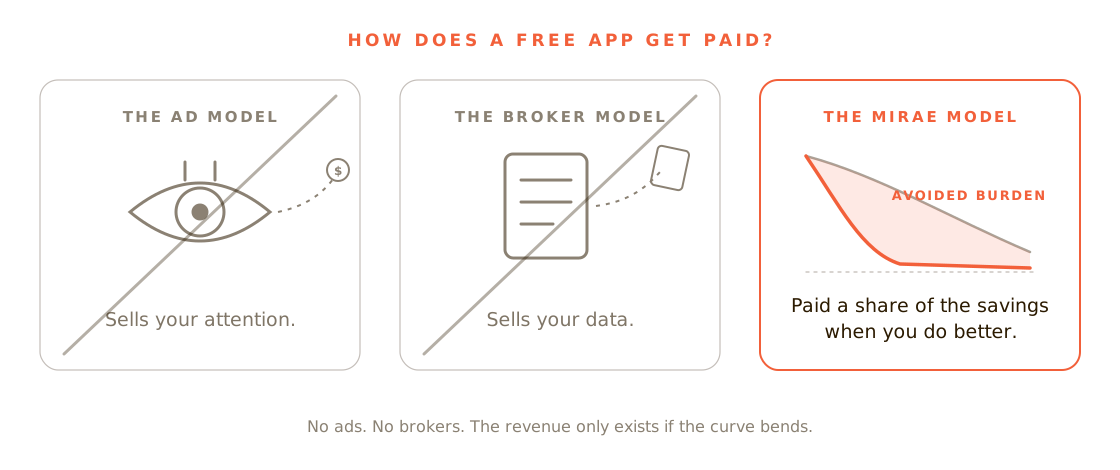
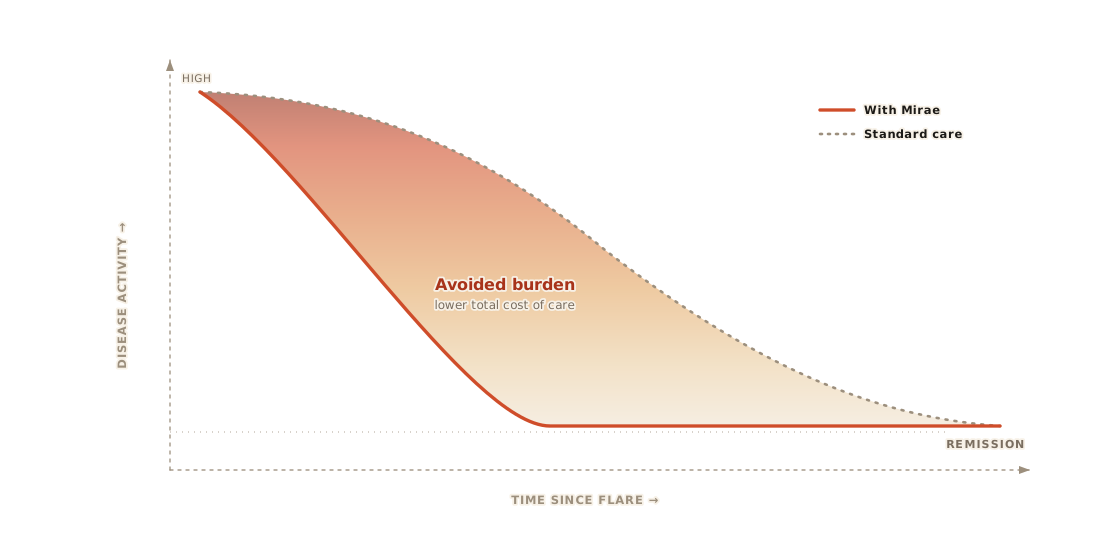
Once our phenotypes are computed across a living population, our approach to precision medicine will become operational: which patients a care team should reach today, whose therapy is drifting, whose escalation is arriving later than it should. In our first issue we called this the measurable delta, the distance between the path a patient is actually on and the path well-timed decisions would have produced. Closing that delta is what risk-bearing health systems pay us for, which is why, as we wrote in July, Mirae is free for patients and paid out of outcomes. The first deliverable of precision medicine will be a decision that drives a clinical outcome. Mirae is building the first tangible deliverable of precision medicine for autoimmune disease not by expensive profiling but by AI decision support at the point of therapy selection.
The mechanism is proven in principle: in a 909-patient randomized trial, telemonitoring built on patient-reported symptoms reduced outpatient visits and hospital admissions (de Jong et al., The Lancet 2017). What has not existed is that relationship fused with the full clinical record and a phenotype model underneath it.
Inverting the funnel: care delivery to drug discovery
Existing approaches to precision medicine in autoimmune disease start with prohibitively expensive biologic or molecular sampling of anonymous patients through the acquisition or licensing of biobanks. Note that this effort is not for care delivery but for drug development, where the promise of a novel target or in-clinic drug asset justifies the exorbitant cost. The binding constraint on drug development is not new molecules; it is the cost of the clinical trial to test the efficacy and safety. A new drug costs somewhere between one and two and a half billion dollars to bring to market, the clinical phases account for roughly two-thirds of it, and the median pivotal trial pays about $41,000 per enrolled patient. In IBD the human bottleneck has become acute. Per-site recruitment into Crohn’s trials fell roughly sixfold over two decades while the number of competing trials rose from four to sixty-three, and about half of screened patients fail eligibility. Meanwhile a mechanism with human genetic or biomarker support is two to two and a half times as likely to survive development as one without.
We think Mirae can solve this problem: earn the trust of patients first, collect longitudinal data (patient-reported and clinical) and apply our models to phenotype patients. Of those defined phenotypes where therapeutic response is measured, sample those subsets only. If a population is already continuously characterized, you do not profile ten thousand unselected patients hoping a signal emerges; you sample the two hundred whose trajectories make them informative: the extreme responders and the primary non-responders to a single mechanism. You solve three problems: cost, signal strength and, perhaps most importantly, recruitment challenges. Our goal is to become a drug discovery company for all autoimmune diseases, and that starts with Mirae being a care delivery intelligence company today.
The loop
For too long, the gap between precision medicine and real-world IBD care felt insurmountable. Mirae bridges that divide. Today, treatment decisions are made with incomplete information, costing patients their time and their original way of life, and impacting their long-term outcomes.
By leveraging data patients already generate, Mirae maps phenotypes to existing therapies and helps clinicians make better decisions, unlocking faster remission and measurable cost savings. Beyond immediate care, these insights streamline target discovery and accelerate patient recruitment for next-generation therapies. Mirae doesn’t just improve bedside care today; we are building the blueprint for the future of medicine for complex chronic conditions.
Anuj Patel
Read More Posts


Let Mirae guide the way forward
Bring your symptoms, food, medications, lab results, and questions together so you can understand what is changing and prepare for your next care conversation. Mirae is free. There is no paid plan, no trial period, and no card needed to start using the app.